CheckRate
    Library
    Housing

    Australian home ownership statistics: how many Australians own their home?

    Australia's homeownership rate sits at 66% according to the 2021 Census, down from around 70% in the 1980s. More households now own with a mortgage than own outright, a shift that first emerged in 2003 and has continued since.

    10 min read 07 May 2026Updated 08 May 2026 Fact checked

    Section 01

    Total homeowners

    How many Australians own their home?

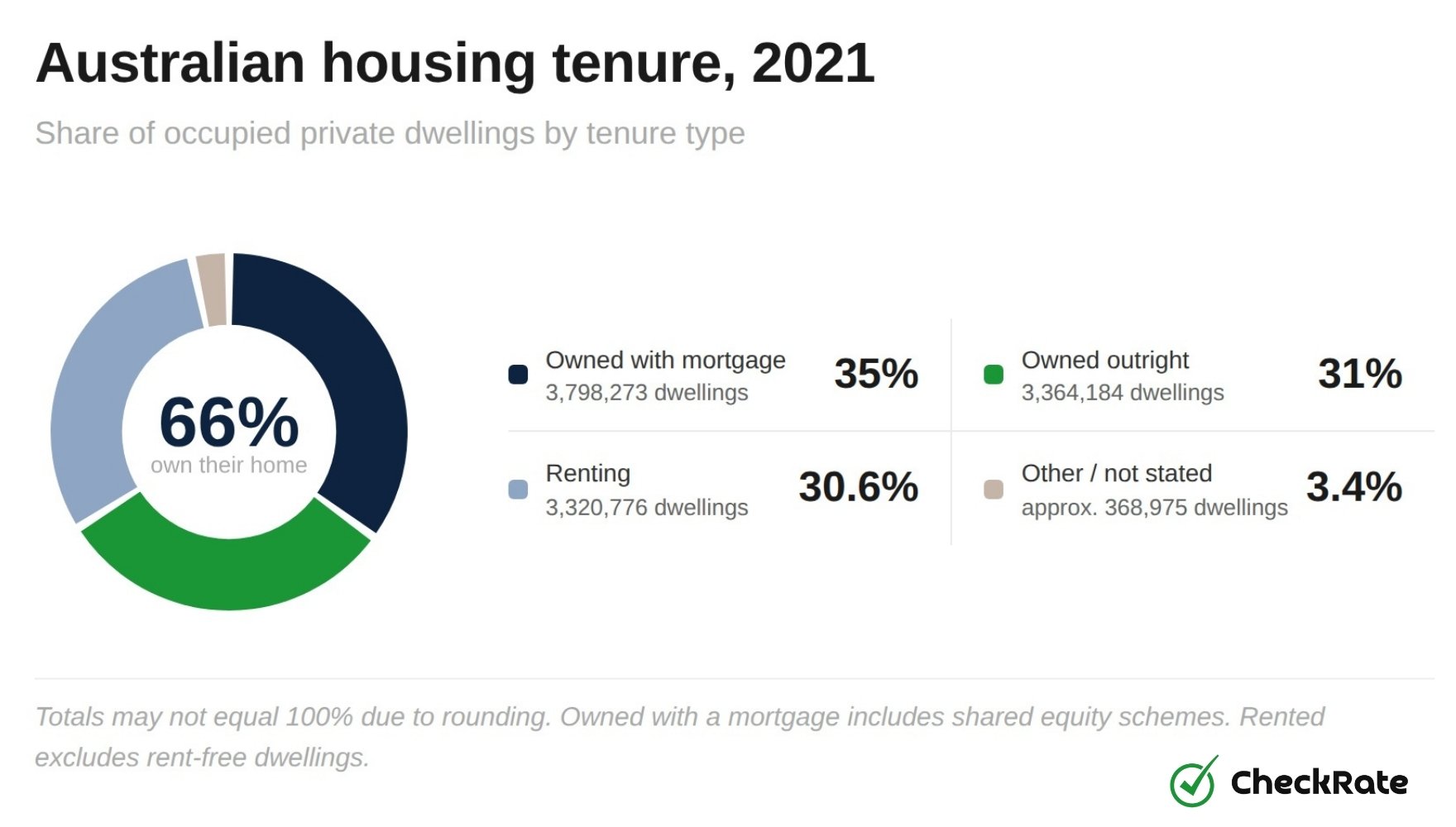
    The 2021 Census counted 10,852,208 occupied private dwellings across Australia. Roughly two in three were owner-occupied, split almost evenly between households that own outright and those still paying off a mortgage. The remaining third rent, either privately or through public housing.

    The combined homeownership rate of 66% has been gradually declining from around 70% in the early 1980s, driven mainly by a fall in outright ownership as property prices rose and mortgage terms lengthened. Since 2003, more households have owned their homes with a mortgage than have owned their homes outright.

    Homeownership rate
    66%
    Owned outright + with mortgage
    Total private dwellings
    10.85M
    2021 Census, occupied
    Owned with mortgage
    3.80M
    35% of all dwellings
    Owned outright
    3.36M
    31% of all dwellings
    Australian housing tenure, 2021
    Share of occupied private dwellings by tenure type

    66%
    own their home
    Owned with mortgage
    3,798,273 dwellings
    35%
    Owned outright
    3,364,184 dwellings
    31%
    Renting
    3,320,775 dwellings
    30.6%
    Other / not stated
    368,975 dwellings
    3.4%
    Source: ABS 2021 Census of Population and Housing.
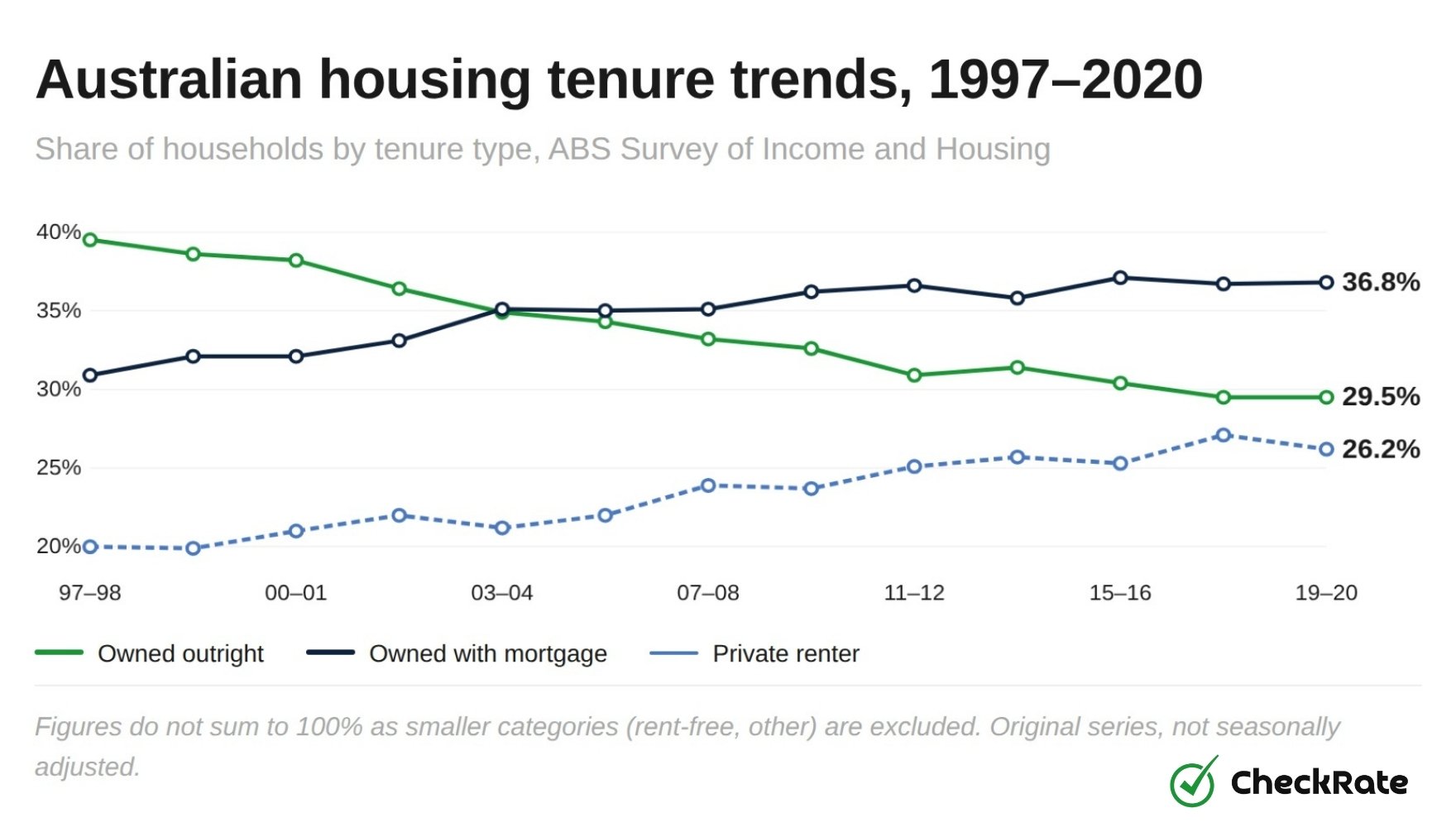
    Yes, gradually. The combined rate of 66% in 2021 sits below the roughly 70% recorded in the early 1980s. Outright ownership has fallen the most, dropping from 39.5% in 1997–98 to 29.5% in 2019–20.
    Long-run shift in ownership
    Around
    70%
    Homeownership rate in the early 1980s
    66%
    Homeownership rate, 2021 Census
    39.5%
    Outright owners in 1997–98
    29.5%
    Outright owners in 2019–20
    Outright ownership has fallen 10 percentage points over roughly two decades. More Australians now own their home with a mortgage than own it outright.
    About the data
    The ABS cancelled the 2023–24 Survey of Income and Housing due to data quality issues, making the 2021 Census the most reliable baseline available for tenure splits. The next SIH results are expected in mid-2027. Where 2025 figures appear in this article, they draw on ABS Lending Indicators, dwelling price data and the RBA interest rate series.

    Section 02

    Mortgage holders

    How many Australians have a mortgage?

    Around 3.8 million households, or 35% of all occupied private dwellings, held a mortgage at the 2021 Census. The national median outstanding debt was $275,000 in 2019–20, with weekly housing costs averaging $493, about 16% of gross household income.

    In 1997–98, outright ownership sat at 39.5% and mortgage ownership at 30.9%. By 2019–20, outright ownership had dropped to 29.5% while mortgage ownership climbed to 36.8%. Private renting has also grown steadily, from 20% to 26.2% over the same period.

    New lending has picked up significantly. In 2025, there were 556,092 new owner-occupier and investor loan commitments, the highest annual total since the 2021 peak, with first home buyers accounting for 119,464 of those. The average new owner-occupier loan reached around $734,000 by the December quarter.

    National median mortgage debt
    $275k
    Outstanding balance, 2019–20
    Average weekly cost
    $493
    For mortgaged households nationally
    Cost as share of income
    16%
    Of gross household income
    Australian housing tenure trends, 1997–2020
    Share of households by tenure type, ABS Survey of Income and Housing
    • Owned outright
    • With mortgage
    • Private renter

    Source: ABS Survey of Income and Housing, 1997–98 to 2019–20.
    Median mortgage debt by state, Australia
    Median outstanding debt among mortgaged households, 2019–20
    ACT
    $347,000
    NT
    $321,000
    NSW
    $302,000
    VIC
    $285,000
    WA
    $280,000
    QLD
    $261,000
    SA
    $216,000
    TAS
    $177,000
    Source: ABS Housing Occupancy and Costs, 2019–20.
    Based on the 2021 Census, 35% of all occupied private dwellings were owned with a mortgage, covering around 3.8 million households. The median outstanding debt was $275,000 nationally in 2019–20.

    Section 03

    Who is buying

    Who is actually buying homes in Australia?

    Age is the strongest driver of home ownership in Australia. Ownership rises sharply through people's 30s and 40s, then levels out in their 60s and 70s. More tellingly, every generation born since the mid-1950s has reached each age group with lower ownership rates than the generation before.

    Australians born between 1947 and 1951 reached a 54.2% home ownership rate at ages 25–29. Those born from 1992 to 1996 had reached just 36.1% at the same stage of life, an 18 percentage point gap.

    Born 1947–51 (at age 25–29)
    54.2%
    Home ownership rate for the post-war generation entering their late 20s
    Born 1992–96 (at age 25–29)
    36.1%
    Home ownership rate for millennials and Gen Z at the same life stage, 18 pp below
    Home ownership by birth cohort and age group, Australia
    Ownership rates (%) at each age bracket, by year of birth
    • 1947-51
    • 1957-61
    • 1967-71
    • 1977-81
    • 1987-91
    • 1992-96

    Source: AIHW analysis of ABS Census data.
    First home buyers by age group, Australia 2019–20
    Share of recent home purchases by age group, first home buyers vs changeover buyers
    • First home buyers
    • Changeover buyers

    Source: ABS Survey of Income and Housing, 2019–20.

    56.1% of first home buyers who purchased in the three years to 2019–20 were aged between 25 and 34, up from 49.6% in 2017–18. The share under 25 remained small at 5.3%.

    Around 24% of changeover purchases in 2019–20 were made by households aged 65 or over, likely reflecting retirees using built-up home equity to downsize.

    According to the ABS Survey of Income and Housing 2019–20, 56.1% of first home buyers were aged 25–34, while only 5.3% were under 25.

    Section 04

    Dwelling types

    What types of homes do Australians live in?

    Of Australia's 10.85 million private dwellings, separate houses make up the majority. The 2021 Census counted 7.7 million separate houses, roughly 71% of all homes. High-density apartments in buildings of nine or more storeys accounted for 394,303 homes nationally.

    Dwelling types, Australia 2021
    Number of residential private dwellings by structure type
    Separate house
    7,699,917
    Townhouse (1 storey)
    753,231
    Townhouse (2+ storey)
    597,289
    Flat / apt (1–2 storey)
    479,622
    Flat / apt (4–8 storey)
    444,338
    Flat / apt (9+ storey)
    394,303
    Flat / apt (3 storey)
    382,041
    Source: ABS 2021 Census, Administrative Data Snapshot.

    The state breakdown tells a clearer story. NSW has the highest share of flats and apartments, driven by Sydney's density. Victoria stands out for medium-density housing, with 237,779 one-storey townhouses, more than any other state.

    Why the Northern Territory looks different
    The NT has Australia's most varied housing mix, with more caravans, cabins and non-standard homes than other jurisdictions. This reflects remote community housing patterns that are not typical of the broader residential market.

    Section 05

    State by state

    Which Australian states have the highest home ownership rates?

    Home ownership is not evenly spread across Australia. Rates range from 59% in the Northern Territory to 69.3% in Western Australia.

    New South Wales
    Total ownership
    64%
    With mortgage
    34%
    Weekly cost (mortgage)
    $574
    Victoria
    Total ownership
    68%
    With mortgage
    37%
    Weekly cost (mortgage)
    $501
    Queensland
    Total ownership
    64%
    With mortgage
    36%
    Weekly cost (mortgage)
    $447
    South Australia
    Total ownership
    69%
    With mortgage
    39%
    Weekly cost (mortgage)
    $390
    Western Australia
    Total ownership
    69.3%
    With mortgage
    42.7%
    Weekly cost (mortgage)
    $443
    Tasmania
    Total ownership
    68%
    With mortgage
    35%
    Weekly cost (mortgage)
    $346
    Northern Territory
    Total ownership
    59%
    With mortgage
    43%
    Weekly cost (mortgage)
    $534
    Australian Capital Territory
    Total ownership
    69%
    With mortgage
    42%
    Weekly cost (mortgage)
    $546
    Home ownership by state and territory, Australia 2021
    Share of dwellings owned outright, owned with mortgage, and renting
    • Outright
    • Mortgage
    • Renting

    Source: ABS 2021 Census of Population and Housing.
    State / territory Ownership Mortgaged Outright Renting Median mortgage Cost % of income
    New South Wales 64% 34% 30% 33% $302,000 17%
    Victoria 68% 37% 31% 29% $285,000 16%
    Queensland 64% 36% 28% 35% $261,000 15%
    South Australia 69% 39% 30% 28% $216,000 14%
    Western Australia 69.3% 42.7% 26.6% 28% $280,000 14%
    Tasmania 68% 35% 33% 29% $177,000 15%
    Northern Territory 59% 43% 16% 40% $321,000 16%
    Australian Capital Territory 69% 42% 27% 28% $347,000 16%
    Australia (national) 66% 35% 31% 30.6% $275,000 16%
    • Northern Territory: the NT has the lowest overall ownership rate at 59% and the highest rental rate at 40%, reflecting the large share of public and community housing in remote areas.
    • Western Australia: WA leads the country with a 69.3% ownership rate. Perth's median dwelling price rose from around $660,000 to $951,000 between 2023 and 2025.
    • Tasmania: records the lowest median mortgage debt at $177,000 and the lowest average weekly cost at $346.
    • ACT: highest median outstanding mortgage at $347,000 and the highest weekly mortgage cost at $546.
    • Queensland and NSW: both sit at 64% ownership. NSW has the highest share of renters at 33%.
    Western Australia had the highest at 69.3%, followed by South Australia and the ACT, both at 69%. The Northern Territory had the lowest overall rate at 59%.

    Section 06

    Affordability

    How affordable is it to buy a home in Australia?

    Saving a deposit remains a decades-long challenge. In 2017, a single income earner saving 4.7% of their income needed roughly 25 years to save a 20% deposit. By 2025, even with a higher saving rate of 6.9%, the median dwelling price of $825,000 still leaves the timeline at around 21 years.

    When household savings spiked to 13.9% during COVID lockdowns in 2020, the deposit timeline fell to around 8.3 years nationally.

    $825K
    National median dwelling price, 2025
    Up from $465,000 in 2015. Sydney $1.515M · Brisbane $1.1M+ · Perth $951K.
    Deposit savings reality, 2025
    21 yrs
    Years to save a 20% deposit nationally on a single income (2025)
    8.3 yrs
    Best recent year was 2020, a pandemic saving spike
    39 yrs
    Years to save a 20% deposit in Sydney on a single income (2025)
    18 ×
    Sydney median multiple (house price to income ratio)
    Single average income ($111,815) at 6.9% saving ratio, 20% deposit on median dwelling price.
    Years to save a 20% deposit, Australia
    National trend, single income at 6.9% saving ratio
    2017
    25.0 yrs
    2019
    18.3 yrs
    2020 ↓
    8.3 yrs
    2022 ↑
    34.5 yrs
    2024
    25.4 yrs
    2025
    21.4 yrs
    Source: ABS National Accounts, ABS dwelling price data.
    Price-to-income ratios across capitals
    Sydney's median dwelling price sits at around 18 times annual earnings. Melbourne, Adelaide and Brisbane are nearly 13 times income. Perth is around 12. For comparison, Vancouver and Los Angeles sit at roughly 15–16 times income.

    Government programmes including the First Home Guarantee, shared equity schemes and state-based stamp duty concessions can help eligible buyers reduce upfront costs. But house prices have outpaced wages for so long that affordability is now a structural problem.

    On a single average income of $111,815 with a 6.9% saving ratio, it takes around 21 years to save a 20% deposit on the median dwelling price of $825,000 in 2025. In Sydney, that extends to about 39 years.
    "Every birth cohort since the 1950s has entered each age bracket with a lower homeownership rate than the one before it. At ages 25 to 29, younger Australians are 18 percentage points below where the post-war generation stood."
    General information only
    This article is based on publicly available ABS data. It is general information only and does not constitute financial advice. If you are making decisions about saving for a property purchase, consider speaking with a licensed financial adviser.

    References

    1. ABS 2021 Census of Population and Housing: housing tenure, dwelling counts and state breakdowns
    2. ABS Survey of Income and Housing: historical tenure trends 1997–98 to 2019–20, mortgage burden by state
    3. AIHW analysis of ABS Census data: home ownership rates by birth cohort and age group
    4. ABS Lending Indicators December Quarter 2025: annual loan commitments by borrower type
    5. RBA / APRA F6 Housing Lending Rates: average interest rates on outstanding and new mortgages
    6. ABS 2021 Census Administrative Data Snapshot: dwelling structure counts by type and state
    7. ABS Total Value of Dwellings: median residential dwelling prices by state
    8. ABS Australian National Accounts: household saving ratio and disposable income
    9. ABS Survey of Income and Housing 2017–18 and 2019–20: recent home buyers by age

    Data Snapshots
    australian housing tenure 2021
    Australian housing tenure, 2021
    australian housing tenure trends 1997 2020
    Australian housing tenure trends, 1997–2020

    Related research

    See more

    Explore all research & analysis

    View all